Biological Innovations

PRP by
Your body, your cure. The future of healthcare

Our core business:

Swiss Platelet Gel Life

Regenerative medicine is a type of medicine that aims to replace or rebuild damaged tissues, In fact, there are cells of our body that have the ability to effectively regenerate tissues normally impossible to repair. Today, Biological Innovations, is more than ever pushed towards regeneration. Our in-depth and continuous study of platelets, of biological mediators contained in them and the optimization of preparations and protocols aimed at allowing their administration for therapeutic use, have allowed to progress and significantly increase the versatility and possible therapeutic applications of Swiss Platelet Gel Life. This sum of knowledge aims to give an answer to the numerous bone, muscle, tendon, cartilage, aesthetic and in general tissue pathologies that are constantly increasing.

The therapeutic potential of PRP is based on its great versatility, efficacy and biosecurity: the use in clinical practice promotes a tissue repair and regeneration process that is as natural as possible and free from toxicity.

The pathologies treated with PRP are manifold. The results of the studies are very encouraging. Biological Innovations the cases treated with PRP have had a high percentage of therapeutic success.

General

Description

The device is a modular system for the preparation of Platelet-Rich Plasma (PRP), used in regenerative medicine for its ability to stimulate tissue repair and regeneration. Thanks to the concentration of growth factors contained in platelets, PRP is applied in various fields:

AESTHETIC MEDICINE
DENTISTRY
TRICHOLOGY
ORTHOPEDICS

It is an autologous, completely natural product obtained by centrifuging a sample of the patient's venous blood in order to separate the blood components and concentrate the platelets. The treatment involves one or more localized injections in the area of interest.

The

Box

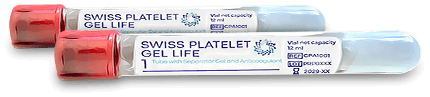
It is a medical device for the preparation of Platelet Rich Plasma (PRP), which includes: glass tubes containing separator gel, anticoagulant and calibrated vacuum for the sampling of patient's blood. The medical device must be used by specially instructed, qualified and trained medical personnel.

The

Tubes

Our tubes are engineered to deliver consistent and reliable platelet-rich plasma preparation. Manufactured from sterile, medical-grade glass or PET, each tube incorporates a closed, vacuum-sealed system with preloaded anticoagulant and a proprietary separator gel to ensure safety and efficiency.

This system uses vacuum-sealed, sterile tubes designed for single use within a fully closed setup to maintain safety and consistency. Each tube is made of medical-grade glass with a specialized coating that helps prevent platelet loss and improve recovery efficiency. With a 12 mL capacity, the tubes support a single spin centrifugation protocol that takes about 5 to 10 minutes. A proprietary separator gel forms a stable barrier to isolate platelets while removing most red blood cells and granulocytes. The tubes come preloaded with anticoagulant, allowing for immediate use and efficient PRP preparation. Typically, each tube yields between 4 and 7 mL of platelet-rich plasma, depending on the centrifugation settings and kit specifications, achieving an enriched platelet concentration of approximately two to five times the baseline value.

The overall process, from blood draw to PRP collection, takes about 10 to 15 minutes. Designed for applications in aesthetics, dermatology, orthopedics, hair restoration, and wound healing, these tubes are marketed as CE marked Class II medical devices. The closed sterile design minimizes contamination risk and ensures consistent, high-quality clinical results.

This controlled process reduces the risk of contamination and ensures reproducibility. Supported by FDA and CE medical device clearance, the tubes are widely utilized across aesthetic medicine, dermatology, orthopedics, hair restoration, and wound care.

The Tube

Tubes Technical Specifications (12 mL)

Category

Details

Tube Format

Vacuum-sealed sterile tubes (single-use, closed system).

Material

Medical-grade glass, coated to prevent platelet loss.

Volume Options

12mL

Centrifugation

Single-spin protocol (simplified workflow, 5-10 min).

Separator Gel

Proprietary gel barrier that isolates platelets, removes most RBCs and granulocytes.

Anticoagulant

Preloaded -

PRP Yield

Average 4-7 mL of PRP recovered per tube (varies by spin settings & kit).

Platelet Recovery

Enriched platelet concentration, marketed as 2-5x baseline.

Time to Prepare

Short processing time (10-15 minutes from blood draw to PRP).

Applications

Aesthetic, dermatology, orthopedics, hair restoration, wound healing.

Regulatory Notes

Marketed as CE-marked Class Il medical devices

Clinical Advantage

Closed sterile system → reduced contamination risk, reproducible output.

Mechanism of

Action and Benefits

Platelets, beyond their role in coagulation, are a biological reservoir of growth factors (e.g., PDGF, TGF-β, VEGF), capable of:

Stimulating cell proliferation

Promoting the synthesis of collagen and hyaluronic acid

Modulating inflammation via cytokines (e.g., IL-10, TGF-β)

Encouraging angiogenesis and tissue regeneration

PRP enhances the body's natural healing response by providing a higher concentration of platelets than normally found in blood.

The

Treatment

PLATELET BIOSTIMULATION

Platelets release numerous platelet growth factors able to mediate the healing of damaged tissues, modulate inflammation and stimulate the formation of new blood vessels. It is therefore possible to exploit this natural function of growth factors to treat orthopaedic degenerative diseases, cartilage or tendon injuries. For this purpose, plasma with high concentration of platelets (PRP) is used.

PRP is made up of 95% platelets and is injected into the site to be treated in order to stimulate tissue repair and reduce inflammation. The growth factors must be injected into a tissue rich in vascularization, from where they can spread to exercise their role of recall and modulation of the cells proposed for healing.

Platelet growth factors in Aesthetic Medicine are used to relieve the signs of aging by stimulating skin regeneration which progressively decreases with age. In fact, over the years our skin loses tone, shine and radiance: growth factors are able to stimulate collagen production and improve vascularization, preventing and delaying aging. The treatment is therefore indicated in the prevention and care of skin aging and photo-aging tissue damage. Once injected into the face and body, growth factors trigger a process of repair, regeneration and therefore rejuvenation.

PROCEDURE

The procedure clearly depends on the purpose of the treatment and the field of application. Generally, PRP is administered in the area to be treated with a minimally invasive procedure. The treatment involves a cycle of sessions, at various temporal ca-dence, in order to induce and maintain a significant and lasting stimulation.

PRP Preparation

Phases
COLLECTION

A modest amount of blood is taken from the patient.

CENTRIFUGATION

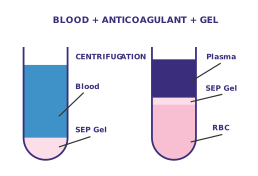
The sample is placed in a centrifuge that presents characteristics suitable for the obtaining of Platelet Rich Plasma

AT THE END OF THIS OPERATION, THREE LAYERS ARE OBSERVED:

PPP

Platelet Poor Plasma

PRP

Platelet Rich Plasma

RBC

Red Blood Cells

SEPARATION

The final product is administered to the patient in the desired area.

Applications and

Effectiveness

The possible applications of PRP in medical field are numerous and the result suffers from a certain subjectivity. Platelet Rich Plasma is used above all in the field of regenerative and plastic surgery but, in clinical practice, numerous other applications have proven to be promising: in dental, orthopaedic and aesthetic field.

Factors that can influence the effectiveness of the treatment with PRP include:

  • The area of the body to be treated
  • The patient's general state of health
  • Whether the injury is acute (e.g. sports injuries) or chronic (if the injury develops over time)..

PRP has many medical applications, with results that vary from patient to patient. While it's widely used in regenerative and plastic surgery, other promising uses include:

DENTISTRY
ORTHOPEDICS
AESTHETICS
UROLOGY
GYNEACOLOGY

IS ALSO ADMINISTERED IN THE TREATMENT OF:

Burns and scars, bedsores

Vascular and diabetic ulcers

Androgenetic alopecia

Dental implants and bone tissue reconstruction in dental field

Correction of face defects

Regeneration of cutaneous and subcutaneous tissues

To improve the appearance of many areas, such as: cheeks, nasola-bial folds, ocular and periocular area (eyelids, "crow's feet", dark circles), lips, forehead, neck and skin folds of the neck, outcomes of acne scars, décolleté and back of the hands.

CONDITIONS THAT ARE TREATED WITH PRP

TRAUMA AND ACUTE INJURIES

Swiss Platelet Gel Life infiltrations are used in the treatment of sports and acute injuries such as knee sprains, ligaments rupture, tears and muscle strains. In orthopaedics, PRP is used to accelerate the healing process of fractures and when application of prostheses are carried out.

TENDON INJURIES

PRP can accelerate the healing of a tendon after an injury.

The infiltrations of Swiss Platelet Gel Life are also used to treat chronic injuries borne by the tendons, as in the case of: tennis elbow, inflammation of the Achilles tendon or pain in the patellar tendon of the knee.

OSTEOARTHRITIS

Therapies based on PRP are applied for the management1 of orthopaedic degenerative diseases, such as osteoarthritis of the knee, hip and ankle.

POST-SURGICAL REPAIR

In cardiac surgery field, Swiss Platelet Gel Life is used to accelerate the wounds healing process.

Warning

The treatment is contraindicated in some conditions, ie in the presence of blood clotting alterations, infectious diseases in acute phase and haematological tumors.

As regards the side effects, risks are minimal and essentially reside in the method and technique of administration.

Alterations, infectious diseases in acute phase and haematological tumors. As regards the side effects, risks are minimal and essentially reside in the method and technique of administration.

PRP Preparation

Phases

Blood clotting disorders

Acute infectious diseases

Hematological cancers

Side effects are minimal and mainly relate to the administration technique.

Discover more

If you want to learn more about Swiss Concept, please get in touch.